 Why Does God Allow Bad Things to Happen?
  The Ten Commandments: 10 – You shall not covet your neighbor’s goods
  The Ten Commandments: 9 – You shall not covet your neighbor’s wife
  The Ten Commandments: 8 – You shall not give false testimony
  The Ten Commandments: 7 – You shall not steal
  The Ten Commandments: 6 – You shall not commit adultery
  The Ten Commandments: 5 – You shall not murder
  The Ten Commandments: 4 – Honor your father and mother
  The Ten Commandments: 3 – Remember to keep holy the Lord’s Day (Sunday)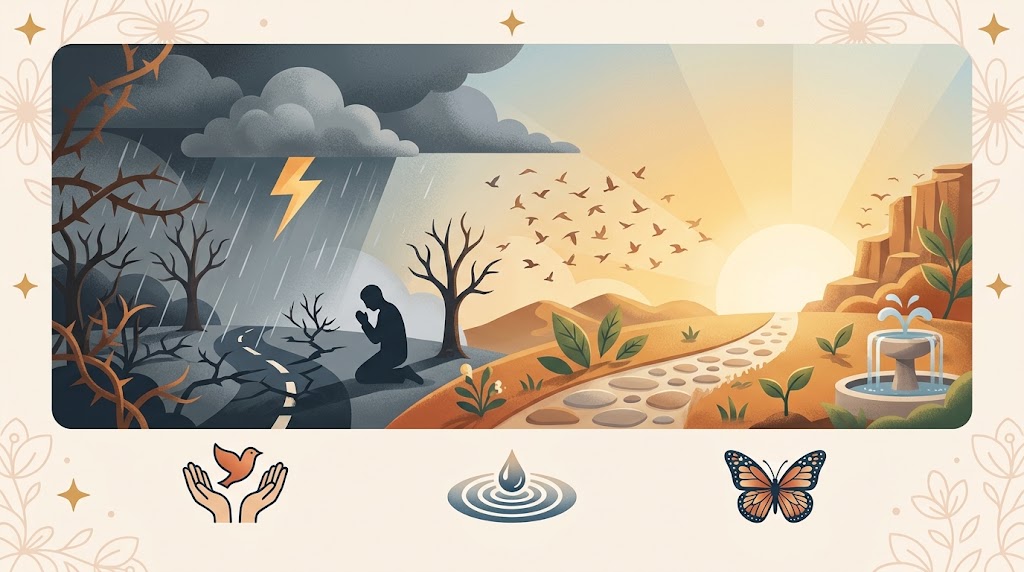
When hardship strikes, when we lose someone we love, or when injustice seems to win, one question rises again and again: If God is all-loving and all-powerful, why does He allow bad things to happen?
The Bible does not avoid this question. From Genesis to Revelation, it speaks honestly about suffering, free will, and God’s love. It doesn’t give us a cold philosophical formula. Instead, it invites us into a story where God brings redemption out of pain.
To understand this mystery, we must look at how God has worked through history—first in the Old Testament, then in the New.
In the Old Testament: Freedom and God’s Greater Plan
In the beginning, God created a world without suffering (Genesis 1). However, He also created humanity with free will. Love cannot exist without choice.
Think of a parent and a teenage child. The parent could lock the doors, control every app, and monitor every message. But then the child’s “love” and “obedience” would be robotic, not real. Real relationship requires real freedom—and real freedom means the child can make bad choices that hurt everyone.
God chose real relationship over a controlled world. That means He also allowed the possibility that we would choose poorly.
When humanity chose rebellion, sin entered the world, bringing decay, pain, and death with it (Romans 5:12).
But God does not abandon us to chaos. Consider the story of Joseph (Genesis 37-50). Joseph was betrayed by his brothers, thrown into a pit, sold into slavery, and falsely imprisoned. It was a series of terrible events. Yet, years later, Joseph told his brothers:
“You intended to harm me, but God intended it for good to accomplish what is now being done, the saving of many lives.” (Genesis 50:20)
What It Shows Us: God does not always stop the bad thing immediately, but He is powerful enough to weave even the darkest human choices into a tapestry of redemption.
In the New Testament: God Enters Our Pain
If the Old Testament shows us God’s overarching plan, the New Testament shows us God’s personal presence in our pain. In Jesus, God did not stay distant from suffering. He entered it.
Look at the story of Lazarus (John 11). When Jesus saw Mary weeping over her brother’s death, He did not offer a lecture on theology. He wept (John 11:35). Even though He knew He would raise Lazarus from the dead, He still grieved.
Jesus then went to the cross—the ultimate example of innocent suffering. He was betrayed, tortured, and killed. God did not stop the bad thing from happening to His own Son. Instead, He used the greatest injustice in history to defeat death forever.
What It Shows Us: God is not indifferent to your pain. He is a God who draws near to the brokenhearted (Psalm 34:18).
What This Looks Like Today
When we face trials, we often look for the “why.” While we may not get a specific answer this side of heaven, we can trust the character of the Answer-Giver.
The Refiner’s Fire: Just as gold is purified by fire, our faith is refined through trials (1 Peter 1:7). God allows pressure not to destroy us, but to strip away what is temporary.
The Tapestry: Imagine looking at the back of a tapestry. It is a mess of tangled threads and knots. That is what our suffering looks like from our perspective. But God sees the front—the beautiful picture He is creating.
The Pruning: A gardener prunes a vine not because he hates it, but because he wants it to bear more fruit (John 15:2). Sometimes God removes something good to give us something better.
Conclusion
Why does God allow bad things to happen? The Bible’s answer is not a sentence; it is a Person.
God allows free will because He desires genuine love. He allows trials because He desires to refine our character. And He allows suffering because He intends to swallow it up in victory.
We live in the “already but not yet.” We live in a world groaning for redemption (Romans 8). But we do not wait in despair. We wait in hope. One day, every tear will be wiped away (Revelation 21:4). The bad things we face today are not the final chapter.
Hold on to this truth: Your current pain is not a sign of God’s absence. It is often the very place where His grace is most powerfully displayed.
Further reading
In the visions of Maria Valtorta we see the following related to this topic:
“You have a destiny. In the mind of God Who creates you, there is a destiny for you. It is the wish of the Father. And it is a destiny of love, of peace, of glory: “the holiness of being His children.” That is the destiny that was present in the divine mind when Adam was fashioned with dust and will be present until the creation of the last soul of man.
But the Father does not denigrate you in your position of kings. If a king is a prisoner, he is no longer a king: he is an outcast. You are kings because you are free in your small individual kingdoms. In your “ego”. You can do what you like and how you like. Before you and on the boundaries of your small kingdom you have a friendly King and two enemy powers. The Friend shows you the rules that He gives to make His followers happy. He shows them and says: “Here they are. With them, your eternal victory is certain.” He, The Wise and Holy One, shows them to you so that you may put them into practice, if you want to, and thus receive eternal glory.
The two enemy powers are Satan and the flesh. By flesh I mean your flesh and the world: they are, the pomps and enticements of the world, that is, the riches, feasts, honors and powers which are obtained from the world and in the world, but are not always obtained honestly and they are used even less honestly when eventually a man reaches them. Satan, the master of the flesh and of the world, speaks also on behalf of the world and of the flesh. He, too, has his rules… Oh! He certainly has! And as your “ego” is enveloped in the flesh, and the flesh is attracted by the flesh, as metal chips are attracted by a magnet, and the singingnlight and among perfumed rose bushes, it is easier to follow those rules, and incline towards those powers and say to them: “I consider you my friends. Come in.” Come in… Have you ever seen an ally who remains honest forever, without asking a hundredfold return for the help he has given? That is what those powers do. They go in… And they become the masters. Masters? No: galley sergeants. They tie you, men, to the galley bench, they fasten you with chains, they do not allow you to raise your head from their yoke, and their lash leaves bleeding marks on your backs if you attempt to escape. You either must bear to be torn to pieces and become a heap of shattered flesh, so useless, as flesh, as to be rejected and kicked aside by their cruel feet, or you must die under their blows.
If you can bear that martyrdom, then Mercy will come, the Only One who can still have mercy on that revolting misery, which the world, one of the masters, now loathes and at which the other master, Satan, throws the arrows of his revenge. And Mercy, the Only One, passes by, bends down, picks it up, doctors it, cures it and says: “Come. Do not be afraid. Do not look at yourself. Your wounds are but scars, but they are so numerous that you would be horrified, as they disfigure you. But I do not look at them. I look at your good will. Because of your good will, you are marked. Therefore I say to you: I love you. Come with Me.” And He takes it to His Country. You then understand that Mercy and the friendly King are the same person. You find the rules He had shown to you and you did not want to follow. Now you want them… and first you reach the peace of your conscience, then the peace of God. Tell Me, now. Was that destiny imposed by the Only One on everybody, or did each choose it for himself? »
« It was chosen by each person. »
« You are right, Simon. Was it possible for Me to go to those who deny the blessed resurrection and the gift of God, to be taught? I came here. I took My soul of the Son of man and I gave it its finishing touches and I thus finished the work of thirty years of humility and preparation in order to be perfect when starting My mission. Now I ask you to stay with Me for a few days in this cave. Our stay will be less depressing because we shall be four friends joining in our efforts against sadness, fears, temptation and the desires of the flesh. I was by Myself. It will be less painful, because it is now summer and up here, the mountain winds lessen the heat. I came here at the end of the Tebeth moon and the wind blowing down from the snowy tops was harsh. It will be less trying because it will be shorter and also because we have the necessary food to satisfy our hunger and in small leather flasks that I asked the shepherds to give you, there is enough water to last us for the days of our stay. I… I must snatch two souls from Satan. It can only be done by penance. I ask you to help Me. It will be a training for you. You will learn how to snatch victims from Mammon: not so much with words as with sacrifice… Words!… The satanic uproar prevents one from hearing them… Every soul which is a prey of the Enemy is enveloped in an eddy of infernal voices…”
Maria Valtorta, The Poem of the ManGod, chapter 80. Jesus Returns to the Mountain Where He Fasted and to the Rock of Temptation.
Visual artwork created via Gemini AI for LovePrayRise